
Theory
My research program considers how basic psychological needs, such as needs for relatedness, competence, and autonomy, are impacted by intergroup processes (Kachanoff, Wohl, Koestner, & Taylor, in press, CDPS).
One line of this research considers how people’s belief that their social group(s) are collectively autonomous in articulating and expressing their own sociocultural identity within an intergroup context without being unduly controlled by other groups impact their basic need for personal autonomy (Kachanoff, Taylor, Caouette, Khullar, & Wohl, 2019, JPSP).
-
I find that people experience less personal autonomy and less psychological wellbeing when they feel that the collective autonomy of their racial, ethnic, and religious groups has been restricted (Kachanoff et al., JPSP). These effects are robust when using cross-sectional, longitudinal, and intensive experimental laboratory simulation research methods. We have also shown the important psychological consequences of collective autonomy for group members within LGBTQ+ communities (Kachanoff, Cooligan, Caouette, & Wohl, in press, Self and Identity).
-
I find that threats to collective autonomy have profound consequences for intergroup relations. Amongst representative samples of Black and White Americans, as well as within simulated laboratory experiments, I show that threats to collective autonomy uniquely predict group members’ desire for power, system challenge, and support and engagement in (sometimes violent) collective action (Kachanoff, Kteily, Khullar, Park, & Taylor, 2020, JPSP).
I also find that collective autonomy support between groups minimizes intergroup conflict and promotes harmonious intergroup relations within challenging intergroup contexts involving intergroup apologies for past transgressions (Kachanoff , Caouette, Wohl, & Taylor, 2017, EJSP) and mass-migration crises (Kachanoff, Kteily, Cohen, & Taylor, invitation to resubmit). My ongoing work is examining how formerly disadvantaged groups respond to having their collective autonomy restricted when they gain control over their social system.
Methodology
An Intergroup Approach to Studying Intergroup Relations
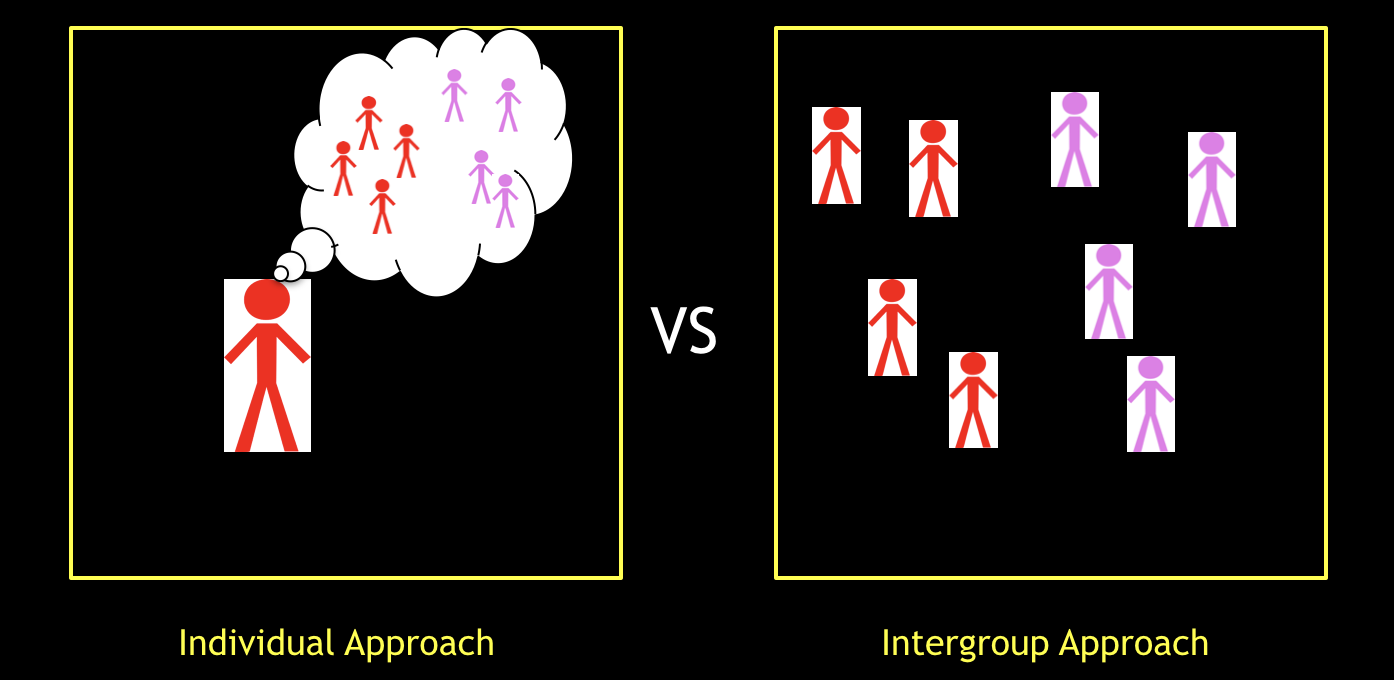
At its core, intergroup relations involve dynamic face-to-face interactions between members within the same group and between members of different groups. Paradoxically however, intergroup processes are often studied using an individualistic survey approach that isolates group members from their fellow ingroup members and physically removes them from the actual intergroup context impacting their group.
I take an intergroup approach to studying intergroup relations by simulating face-to-face and group-on-group interactions in the laboratory using intensive role-playing studies. These studies involve recruiting multiple participants into the laboratory at one time and then dividing them into several sub-groups. Participants then form meaningful identities as a group, and negotiate complex intergroup scenarios that they imagine are taking place within a fictional world created for the purpose of the study.
Using this approach I have simulated intergroup contexts involving groups losing the freedom to express their cultural practices (Kachanoff, Taylor, Caouette, Khullar, & Wohl, 2019, JPSP; Kachanoff, Kteily, Khullar, Park, & Taylor, in press, JPSP), and a mass-migration situation between two groups in which one group actually physically relocates into the territory of the other group (Kachanoff, Kteily, Cohen, & Taylor, invitation to resubmit manuscript). In my ongoing research I am simulating an inversion of social hierarchy in which formerly oppressed group members gain control over their social system and can influence the outcomes of their former oppressor as well as other low power groups in society.
Forming Meaningful Identities in the Lab
Central to my intergroup approach is having newly formed groups of participants form meaningful sociocultural identities in the laboratory and potentially experience having their culture forcefully restricted by another group.
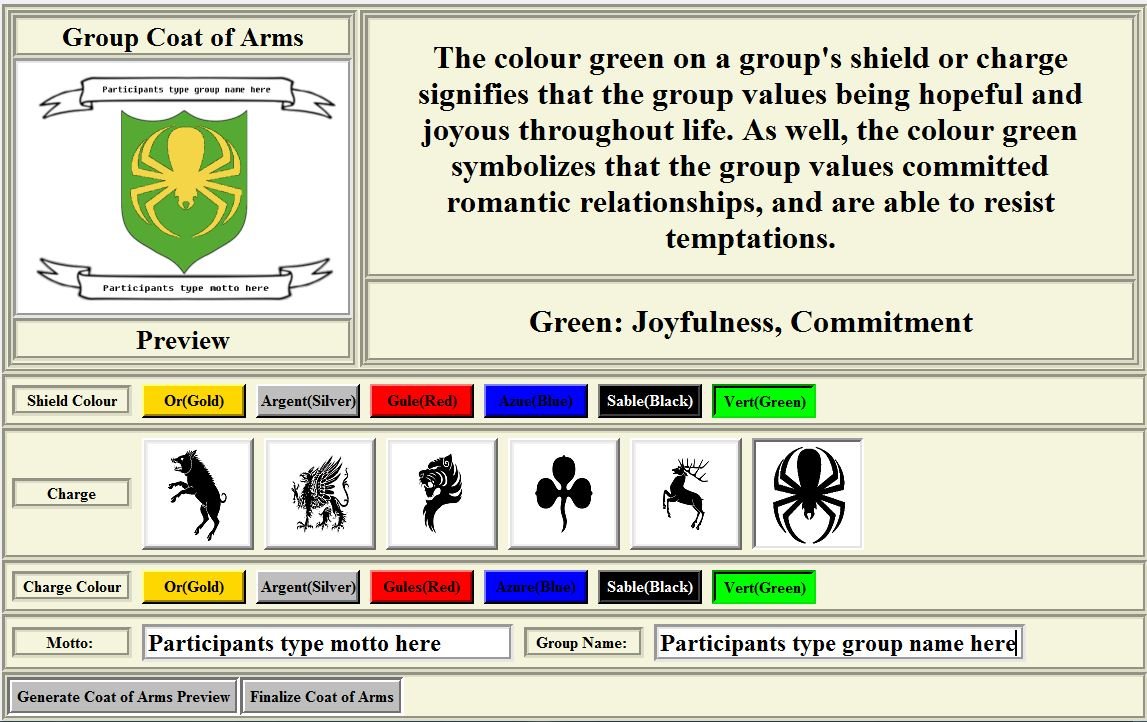
I have developed the coat of arms paradigm to facilitate groups forming a meaningful group identity in the laboratory (Kachanoff et al., 2018, JPSP). Group members determine the core traits and values they share as a group and symbolize them with different colours and symbols adorned on a shield (download the coat of arms program HERE).
These identities are meaningful to participants. Groups take on average 15-20 minutes to create their coat of arms. When groups have their coat of arms forcefully changed by another group they will fight to restore it. For example, below is an image of a coat of arms that a group tried to restore to its original version once it was forcefully changed by another group.